What to Wear for a Mountain Engagement Session or Elopement
What to Wear in the Mountains
The outfit question is really two questions wearing a trench coat: what looks good in a photograph, and what you can actually move in for four hours on a mountain. Most advice answers the first and ignores the second.
Here's what I've watched work and fail across a few hundred sessions in the Whites — starting with the one rule that matters more than color.
What should you wear for a mountain engagement shoot?
Choose one outfit with movement and one with structure, in colors that sit alongside the landscape rather than competing with it. Fabric that moves — a long skirt, an unbuttoned overshirt, anything with drape — reads far better in wind than something stiff. Above all, wear something you can walk uphill in without thinking about it.
That last point is the whole game. The photographs people love from these sessions are almost never the posed ones. They're the in-between moments — laughing at the wind, scrambling over a boulder, leaning into each other because it's cold. You can't get that from someone who's worrying about their clothes.
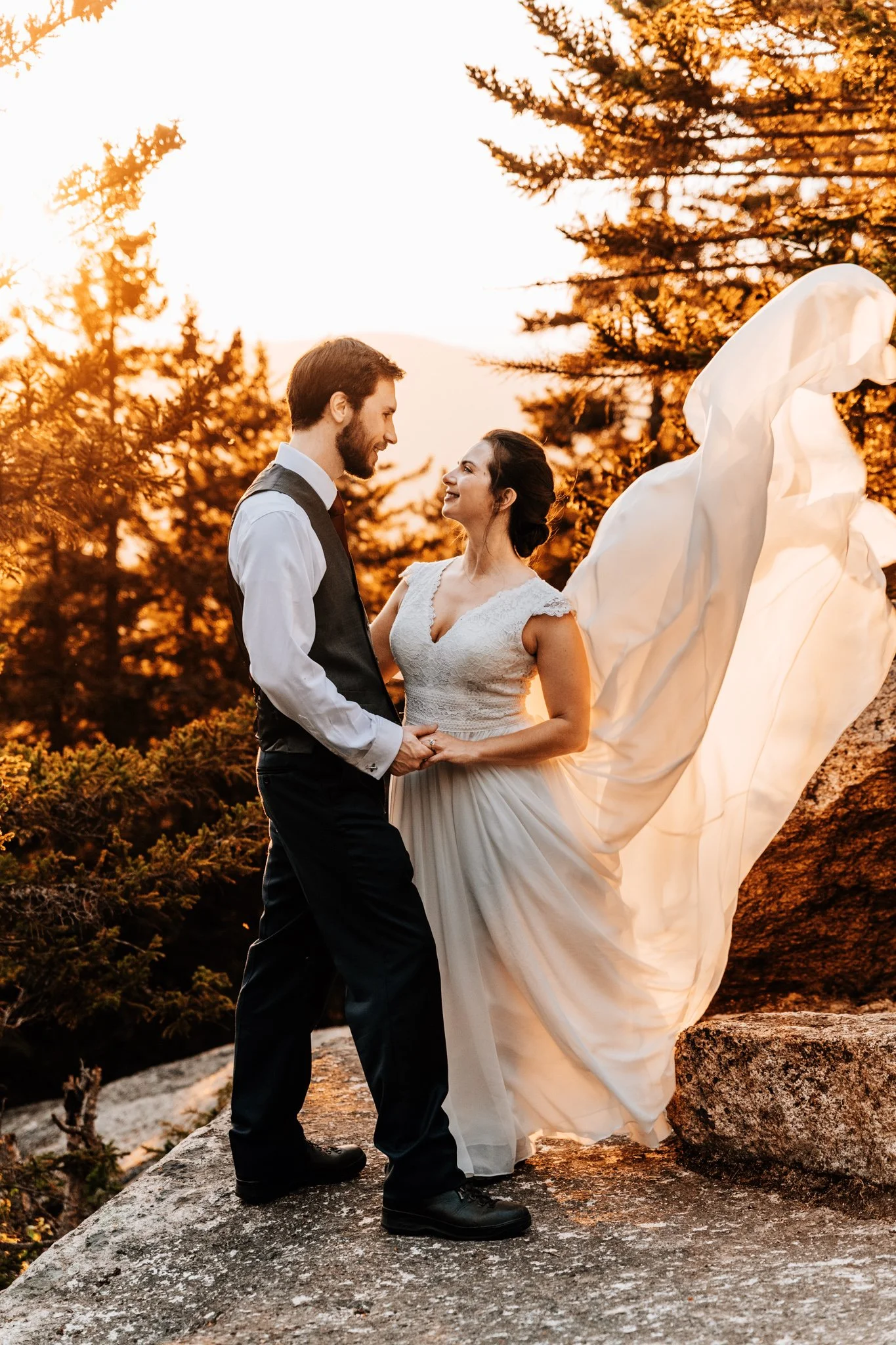
Fabric that moves does the work for you.
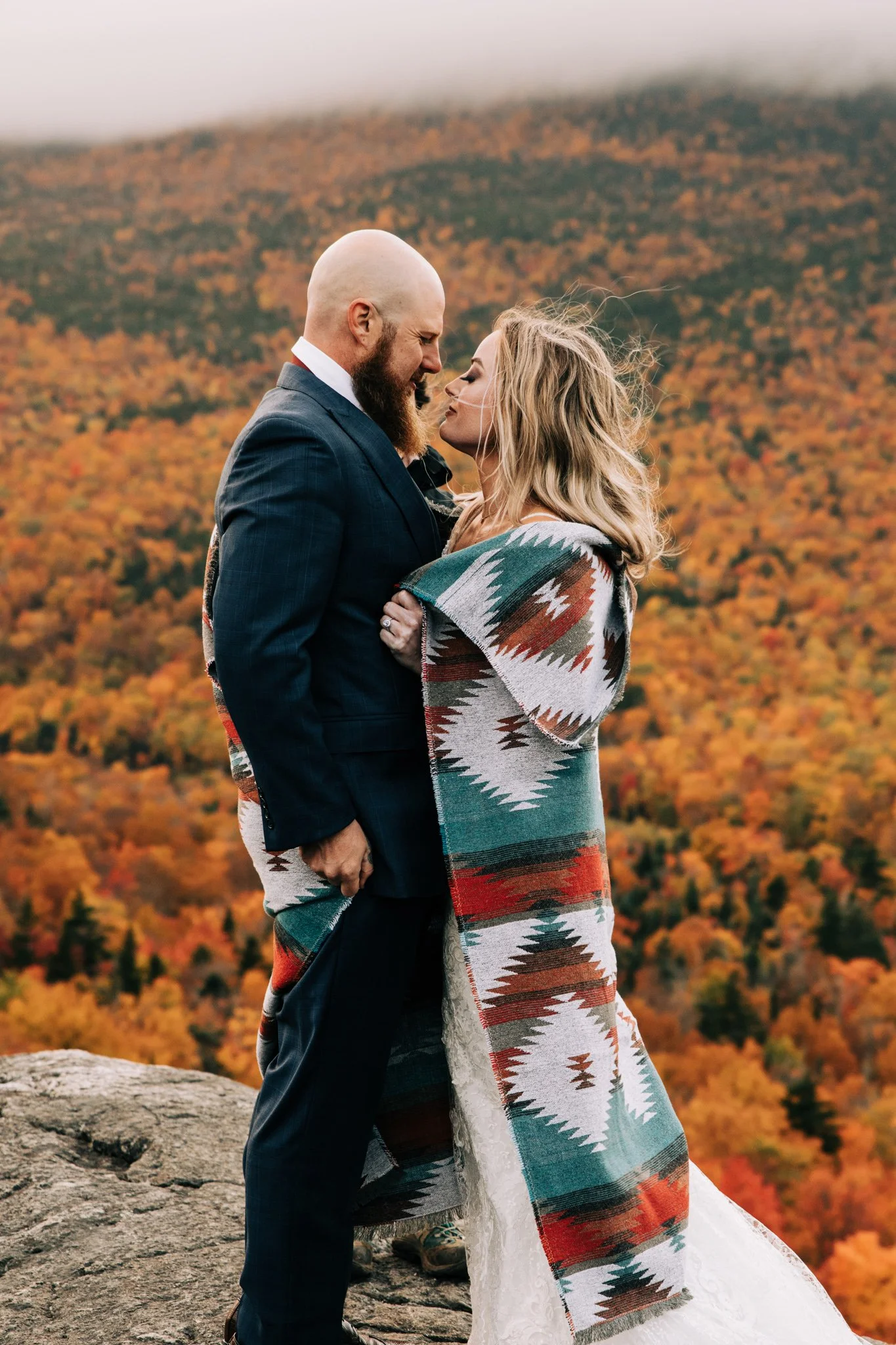
Texture reads. Flat color doesn't.
The test I give everyone: put the outfit on and walk up a flight of stairs twice, quickly. If you adjusted anything on the way, it's the wrong outfit for a mountain.
What colors photograph best in the White Mountains?
Warm neutrals, rust, deep green, oatmeal, cream, and muted blues all sit naturally against granite, spruce, and autumn color. Avoid pure white in bright sun, which clips to a flat blank, and avoid strong neon or logo-heavy technical wear, which pulls the eye straight off your faces.
Black is worth its own note. It works beautifully in winter against snow and rime, and it tends to go heavy and shapeless against summer green — the detail in the fabric disappears and you're left with a silhouette.
What should you wear for a fall foliage engagement session?
In peak foliage the landscape is already saturated orange and red, so the usual advice inverts. Wear cream, oatmeal, soft gray, deep green, or navy and let the trees supply the color. Rust and burnt orange, which work beautifully in September, tend to disappear into the background in mid-October.
This catches people out constantly. They pick the autumn palette, arrive at peak color, and blend into the hillside. If you want to stand out in October, go quieter than you think.
Should you and your partner match?
Coordinate, don't match. Pick two or three colors you both draw from and vary the texture between you — knit against linen, wool against cotton. Identical colors read as a uniform, and clashing patterns fight each other.
The simplest reliable approach: one of you in a lighter tone, one in a deeper tone from the same family. It photographs as intentional without looking coordinated.
Works
- Texture — cable knit, linen, wool, suede
- Long lines and drape that catch wind
- Layers you can remove and re-add
- Muted tones drawn from the landscape
- Something you've already worn once
Fights you
- Pure white in midday sun
- Visible technical logos and neon trim
- Anything stiff, tight, or unforgiving
- Brand-new shoes of any kind
- Busy patterns on both of you at once
Can you hike in a wedding dress?
Yes, and plenty of couples do. Some change at the summit or at the destination, carrying the dress up in a pack. Others hike in it the whole way. A shorter dress, or one without a long train, handles trail perfectly well. If you want a long train, look for a detachable one — or wear a pack and wrap the skirt up into the hip straps.
The hip-strap trick is the one most people haven't heard. You gather the skirt and tuck it under the hip belt of your pack, which lifts the fabric clear of wet rock and mud for the whole climb and drops back down in about five seconds when you arrive.
If you'd rather change at the top, a dry bag or garment bag rolled into a 30-liter pack carries a dress without much creasing — and what does crease usually falls out in the wind within ten minutes.
What shoes should you wear for an alpine elopement?
Wear real hiking footwear for the approach and carry anything else. White Mountains trails are rooted, rocky, and frequently wet, and the descent is where people get hurt — tired legs, loose rock, and a tendency to hurry once the photographs are done.
Boots photograph better than most people expect under a dress. They read as honest rather than incongruous, and they're a big part of why these images look like something you actually did rather than something you posed for. There is no photograph worth a rolled ankle two miles from the trailhead.
How do you layer for a cold-weather shoot above treeline?
Build from a wool or synthetic base layer, add an insulating mid layer, and carry a windproof shell. Never wear cotton against your skin in the cold — it holds sweat, stops insulating, and makes you genuinely unsafe once you stop moving.
The practical trick for photographs is that layers come off for a few minutes at a time. You stay in the puffy right up to the moment the camera comes up, strip down for two or three frames, and put everything back on. Nobody is cold for more than a couple of minutes at a stretch, and the images don't show a single layer of it.
What should you bring in your pack?
- Water and snacks — more than you think for a sunrise start.
- A headlamp for every person. Not optional on a sunrise start, even in summer.
- More layers than you expect to need, including gloves and a hat above treeline in any season.
- A brush or comb, because wind will undo whatever you did at 4 AM.
- Safety pins, blister bandages, and a microfiber cloth for mud on hems.
- A small first aid kit, and a bag for everything that comes back out with you.
On flowers and anything loose: the alpine zone is fragile and petals don't decompose up there the way people assume. Whatever comes up the mountain goes back down it. More on what leave no trace means in practice.