Small Wedding Venues in New Hampshire
Most venue lists are assembled by someone who has never stood in the room. This one isn't a ranking. It's the three shapes a small White Mountains wedding tends to take, what each one costs you in flexibility, and the questions I'd ask before signing anything.
I photograph roughly a dozen of these a year. The couples who end up happiest are almost never the ones who found the prettiest venue. They're the ones who understood what their venue would ask of them on the day — how far guests walk, what happens when the weather turns, whether dinner is a hundred feet away or forty minutes down a mountain.
What counts as a micro wedding in New Hampshire?
A micro wedding is a full wedding day scaled to roughly 50 guests or fewer. You still have a ceremony, a meal, toasts, and a first dance if you want one. What you drop is the infrastructure a large guest count forces on you — a big block of hotel rooms, a seating chart that takes weeks, a venue chosen because it holds 150 people rather than because you love it.
Fifty is a soft number. The line that matters more is whether everyone can hear you say your vows without a sound system, and whether you can have a real conversation with every person there before the night ends. In the White Mountains that tends to land somewhere between 20 and 40.
What is the difference between a micro wedding and an elopement?
An elopement is built around the two of you, with maybe a handful of witnesses, and usually no reception. A micro wedding keeps the structure of a wedding day — guests, a venue, a meal, a timeline — at a smaller scale. The practical difference is that a micro wedding needs a venue that can host and feed people, and an elopement often needs no venue at all.
This matters more than it sounds. An elopement can happen on a summit ledge with a permit-free headcount and no vendor beyond a photographer and an officiant. The moment you add a dinner for thirty, you have inherited a logistics problem, and the venue is how you solve it.
If you're still deciding between the two, the honest test is whether you'd be relieved or sad if nobody came. There's no wrong answer, but the answer picks your venue for you. If it's the former, start with where to elope in New Hampshire instead.
What are the best small wedding venues in the White Mountains?
They fall into three groups, and the group matters more than the individual property. Pick the shape first.
Lift-Served Summits
A genuine mountaintop ceremony your grandparents can attend. The resort owns the terrain, so headcount stops being a constraint.
Inns With Views
Ceremony, dinner, and beds on one property. Nobody drives after dark. The trade is that you inherit the inn's aesthetic.
Rented Houses
Total control of the day and the look. You are also the caterer, the rental company, and the cleanup crew.
One thing no list will tell you: the drive between ceremony and reception is the single biggest predictor of how the day feels. Twenty minutes is fine. Fifty minutes in October traffic on Route 16 will eat your golden hour and your guests' patience.
Loon Mountain
Lincoln · Pemigewasset Valley
Guests ride the White Mountain Express Gondola to Loon Peak, and the ceremony happens in a built amphitheater set among pines and hemlocks rather than on bare ledge. That tree cover is the underrated part — it means the site still works in wind that would make an open summit miserable.
Loon is the most developed summit wedding operation in the state, which cuts both ways. The logistics are handled and the site is genuinely beautiful. It's also a resort, and you'll be sharing the mountain with the public unless you've arranged otherwise. Ask about that directly.
Cranmore Mountain
North Conway · Mount Washington Valley
Cranmore is the one venue on this list that sits at the edge of a town. Guests can stay in North Conway village and be at the base in minutes, then ride a four-person chairlift on a seven-minute trip to the summit. Up top, the Meister Hut seats 100 inside and 150 with the wraparound patio, and Cranmore pitches it as a cocktail-hour venue with a view across the valley.
The split is what makes it work for a small wedding. Fairbank Lodge at the base handles ceremony, cocktails, and reception for up to 200, and it gives you a real indoor option if the weather turns. What you trade is speed. A chairlift moves guests four at a time in the open air, so ask how long it takes to get your whole group up and down, and warn anyone in long skirts or heels. If a summit ceremony is the point, ask exactly where it can happen.
Ask both of these the same question: what wind speed stops the lift, and what happens to my ceremony when it does? The answer separates a venue with a real plan from one that will improvise on your wedding day. At Cranmore, also ask how wedding lift service works around the public scenic chairlift, which runs Thursday to Sunday through mid-October.
Sunset Hill House
Sugar Hill · Franconia Notch
Sugar Hill sits on a shoulder with an uninterrupted westward view toward Franconia Ridge, and the property is built to take advantage of it. Ceremony on the lawn, dinner inside, guests upstairs — the whole day happens within a few hundred feet.
This is the shape I'd point most couples toward if they want a wedding rather than an adventure. The photographs are gentler than a summit, but nobody spends the day worrying about logistics.
Whitney's Inn
Jackson · Mount Attitash
Jackson is the prettiest village in the Whites and Whitney's leans fully into it — unfussy, warm, with enough rooms on site that the weekend becomes the event rather than the wedding day alone.
Choose this if your people travel well together. It's a poor fit if you want anything formal.
Toad Hill Farm
Franconia
A working-farm setting with a genuinely enormous view of the ridge and Cannon Mountain. Field weddings photograph beautifully in the last hour of light because there's nothing between you and the horizon.
Field also means no walls. Wind, bugs in early summer, and a rain plan that has to be real rather than theoretical.
The other option nobody lists: a well-chosen rented house. If your guest count is under twenty and you're willing to bring in a caterer, a house with the right view outperforms most venues — and you control every hour of the day. I've written about the properties I shoot if you want a sense of what works.
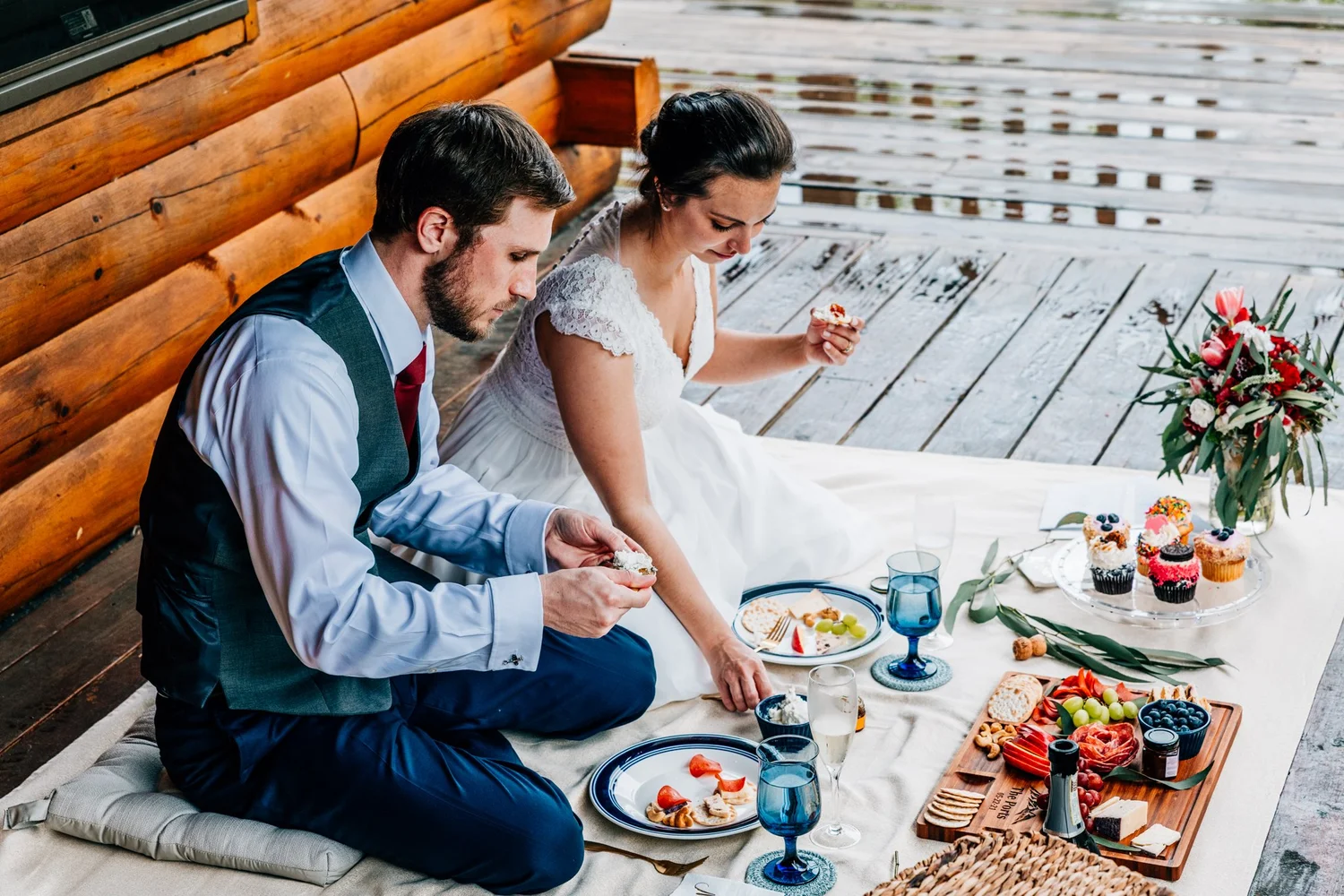
A rented house, a picnic on the deck, no venue required.
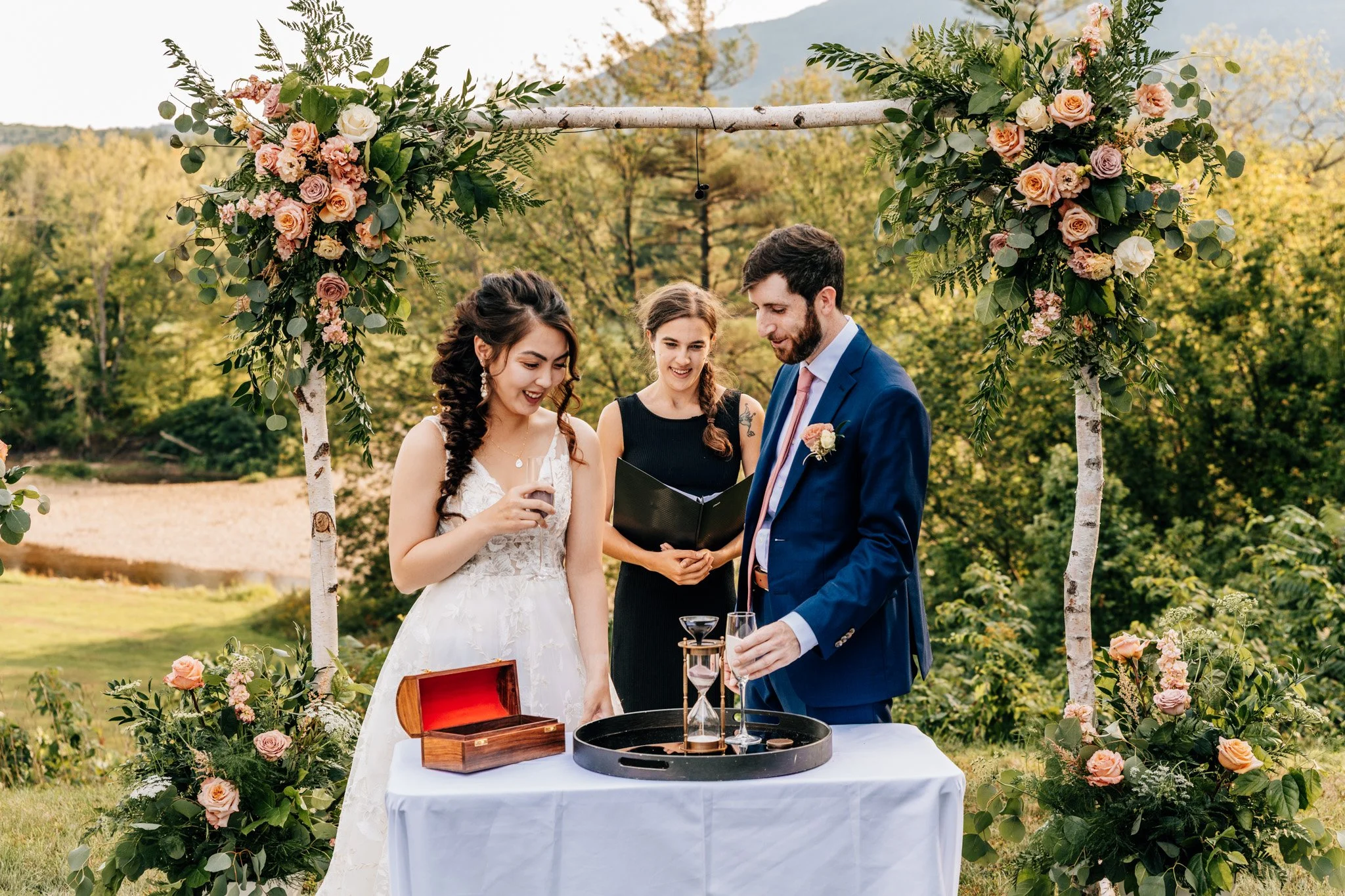
Do you need a permit for a wedding ceremony in the White Mountain National Forest?
For a non-commercial gathering, the White Mountain National Forest requires a special use permit at 75 or more people, and the Forest Service counts spectators. Almost every micro wedding sits well under that line, so for most couples reading this, the answer is no.
No permit doesn't mean no rules. On any national forest ground you can't close off or cordon an area, bring in vendors or food carts, or throw rice, birdseed, confetti, or lanterns, and balloons and crepe-paper decorations are out too.
The exception catches people out. The summit of Mount Washington is not national forest — it's Mount Washington State Park, a roughly 59-acre parcel owned by the State of New Hampshire and surrounded by the forest. Different landowner, different rules. If your ceremony is on the summit itself, you're dealing with NH State Parks, not the Forest Service.
If you do need a forest permit, contact the WMNF Special Use Team at 603-536-6136 and allow at least 45 days.
How many guests can you have at a hiking elopement or micro wedding on public land?
Ten or fewer, counting everyone. That's you two, your photographer, your officiant, and every guest. Ten is the actual rule in White Mountain National Forest wilderness areas — the Pemigewasset, Great Gulf, and Presidential Range–Dry River among them — where hiking and camping groups are capped at ten. It's also a sound limit for any trail, wilderness or not.
Do the arithmetic before you build a guest list. With a photographer and an officiant, ten people leaves you six guests. That's the number a hiking ceremony is designed around.
Hike in, anywhere
Couple, photographer, officiant, and about six guests. This works on any trail, including wilderness, and it's the size at which the group can move quietly and settle onto a ledge without anyone standing somewhere precarious.
Short walk, durable ground
The outer edge, and only outside designated wilderness. It works on solid rock or an established site close to a trailhead, where the group can spread out and leave nothing behind. This is my judgment rather than a rule, but it matches the common guidance among outdoor planners who work from Leave No Trace principles: keep public-land groups under about fifteen.
Legal, but not a hike
You don't need a permit, but a group this size is no longer a trail party. Once more than about fifteen people are hiking, somebody is slow, somebody is underdressed for the wind, and you spend the ceremony window waiting. This is what the venues above are for: a place built to take the group, with seating, shelter, and a plan for weather.
Permit required
A special use permit from the Forest Service, applied for at least 45 days out. At this size you're better served by a venue than a forest permit.
Why keep the group small?
The limit isn't bureaucratic. Group size is the most direct lever you have over how much a ceremony takes from the place you chose. It shows up in three ways.
The Land
Footprints compound with every extra person, and trampled ground draws the next hiker onto the same line, which is how social trails and erosion start. The alpine zone is the worst place to learn this: the plants there live at the edge of what they can tolerate, in thin soil that took a very long time to build, and a boot print can outlast the wedding album.
Wildlife & Ecosystems
Bigger groups are louder, and animals react more strongly to people moving unpredictably than to people who stay on a defined path. Anything that reads as food — rice, confetti, birdseed, a dropped snack — teaches wildlife to associate people with a meal, and a habituated animal rarely ends well. Fewer people means less noise, less spread, and less to clean up.
Other Visitors
A summit ledge is one place with room for a few people, and everyone who hiked up came for it. Fifteen people in formal wear, a photographer, and a ceremony can take the whole view for half an hour. The Forest Service doesn't allow closing off a site for good reason. A small, quick, quiet party shares the mountain; a big one occupies it.
Want the mountain and a bigger guest list? Split the day. Exchange vows at sunrise or on a quiet weekday ledge with just the two of you and a witness or two, then bring everyone together for dinner at an inn or house. You get the ceremony you'd never trade and a celebration everyone can attend. More on how I approach this in Leave No Trace elopement photography.
How far in advance should you book a White Mountains wedding venue?
For a Saturday during foliage season — roughly the first three weeks of October — twelve to eighteen months is realistic, and the best inns go earlier than that. For a weekday, or for late spring and early summer, six to nine months is usually enough.
Midweek in September is the most underrated slot in the calendar. The light has turned, the summer crowds are gone, the early color is starting at elevation, and you can still get a room.
What happens if it rains on your White Mountains wedding day?
Ask every venue what their rain plan actually looks like, and ask to see the room. Not a description of the room — the room. A lift stops running in lightning and high wind, so a summit ceremony needs a real indoor alternative at the base.
The venues that struggle are the ones whose only backup is a tent that has to be committed to days in advance, which means making a weather call on Tuesday for a Saturday in a mountain range that changes its mind hourly.
Every plan I build includes a lower-elevation backup, because the Whites will make you use it eventually. That isn't pessimism — it's what lets you keep the summit plan without gambling the whole day on it.
Ready?
Let's Find the One That Fits
No pressure. Just a conversation.
I've shot in most of these places and I'll tell you honestly which one suits the day you're describing — including when the answer is none of them. That conversation costs nothing and it's usually the most useful hour of the whole planning process.
Working out the legal side too? Start with how to legally elope in New Hampshire.